

February 12, 2026
The US housing stock is old. Almost half of all owner-occupied homes were built before 1980, and more than a third before 1970. These homes, which are disproportionately occupied by lower-income households, are more susceptible to poor insulation, air leakage, and inefficient HVAC systems and appliances, leading to significant energy waste and high utility costs. As a result, LMI households are estimated to spend three times more of their income on energy bills than higher-income households.
At the same time, new housing construction continues to fall behind due to labor shortages, rising material costs, and high interest rates, not to mention the previously low interest rates from the pandemic era that discourage homeowners from moving. All of these factors are shifting more and more attention toward renovating existing homes rather than replacing them. In fact, only 10% of home sales in the US are new. With existing inventory of homes representing the overwhelming majority of US housing stock for years to come, decarbonizing the residential housing sector - which accounts for about 20% of US primary energy consumption - relies not just on innovating new builds but more importantly retrofitting old ones with energy efficiency.
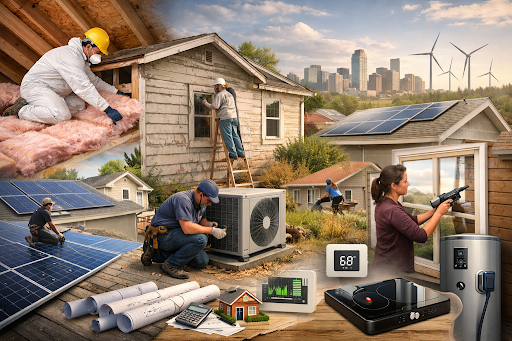
There is no single path to an energy-efficient home. Options for energy retrofitting range from low-cost interventions like improving insulation, air sealing, and ventilation (i.e. passive solar heating and cooling) to replacing old HVAC systems and water heaters with heat and water pumps, and installing energy efficient appliances and cooktops. More intensive upgrades like installing solar panels or installing energy efficient windows can also go a long way in reducing a household’s energy footprint.
If the solutions are so straightforward, why aren’t we seeing an explosion of retrofit projects at the scale needed to make a difference? For one, high upfront costs combined with a lack of awareness around longer-term payback deter homeowners from even pursuing the option. And homeowners who do end up participating in retrofits are effectively asked to become their own general contractor - juggling outreach to multiple specialists, comparing quotes, navigating high-stakes decisions, and trying to make sense of their options.
While financial assistance is in place to support retrofitting, it is fragmented across a wide range of federal, state, utility, and green lending programs. These programs vary depending on location, type of home, income, and upgrade measure, making it incredibly complex for homeowners to understand their eligibility and apply for incentives and rebates. If they do apply, many find the requirements, audits, and compliance paperwork to be prohibitively burdensome. The DoE’s Weatherization Assistance Program, which aims to provide low-income households with free, energy-efficient home upgrades, reaches less than 3% of eligible households each year.
This is where digital infrastructure becomes essential. Properly designed digital tools can transform energy retrofits from a fragmented, manual process into a coordinated ecosystem that works for homeowners, contractors, and program administrators.
Digital retrofit platforms can offer home upgrade recommendations customized to the household and translate complex information into clear choices, cost estimates, and projected savings so families can make better decisions. Centralized eligibility platforms can determine which incentive or rebate program will best apply to a given home, automatically generate compliance documentation, and streamline forms and application submissions. Digital marketplaces can connect vetted contractors and skilled workers, manage bids and schedules, track project progress, and facilitate payments. These features help build homeowner trust by increasing transparency and reducing uncertainty around the quality, cost, and delivery of their home improvements. Digital measurement and verification tools can also help prove that retrofits deliver real results. By analyzing pre- and post-installation energy use or modeled savings, these systems can support program compliance, enable performance-based funding models, and build a credible evidence base for future investment.
The opportunity around US energy retrofitting does not rest on a single technology or product, but rather a digital backbone that allows funding, labor, data, and decision-making to move together. When these systems are designed with lower-income households at the center, retrofitting becomes not just a climate solution, but a pathway to more affordable, resilient, and dignified housing. At the iBUILD Global Foundation, we see energy retrofitting as a delivery challenge, and delivery challenges are exactly where digital tools can have the greatest impact. By reducing friction, improving coordination, and centering equity, we can unlock the full potential of energy retrofits for millions of households across the United States.


Copyright © 2026 iBUILD Global Foundation. All Rights Reserved. iBUILD Global Foundation is a certified 501(c)3.